AI Humanizer Comparison: How to Actually Judge One

Alex Halpin
7/27/2026

Search "best AI humanizer" and you get a wall of near-identical listicles: I Tested 30+ AI Humanizers, I Re-Tested 30+ in 2026, I Tried 20+ This Past Year. Nearly all of them are published by companies that sell one of the tools being ranked, and the tool that wins is nearly always the publisher's.
So this article does something different. I am not going to hand you a leaderboard, because I have not run controlled tests across every tool on the market and neither, in any verifiable way, has anyone else writing these posts.
What I can give you is a framework for judging any humanizer yourself, an honest account of how the main players differ, and a clear explanation of why the numbers you are being shown do not mean what you think.
Why the bypass rates you see are worthless
Almost every humanizer advertises something like "99.8% bypass rate." Before you weight that at all, ask four questions:
- Against which detector, at which version? Turnitin, GPTZero and Originality.ai all update their models continuously. A bypass rate is a snapshot against one model on one day. Nobody publishes the version they tested.
- How many samples, and of what? Twenty paragraphs of generic marketing copy is a different test from two hundred graduate essays. Sample size is almost never stated.
- What counted as a pass? Under 20% AI? Under 5%? Zero? The threshold changes the headline number enormously and is almost never disclosed.
- Who ran it? If the answer is "the company selling the tool," the result is a marketing asset, not a measurement.
I have not seen a single humanizer vendor — including tools I would otherwise rate well — publish a claim that survives all four questions. That includes us. When we say something works, treat it with the same scepticism.
There is a deeper problem too. Even a genuine bypass rate is measuring the wrong thing, because detectors themselves are unreliable. A peer-reviewed study in Patterns found seven major detectors misclassified 61% of TOEFL essays written by non-native speakers as AI-generated. If the measuring instrument has that error rate on human writing, a tool's score against it is not a quality signal.
The five things actually worth comparing
These are the dimensions that do not change week to week.
1. Meaning preservation
This is the one that matters most and gets discussed least.
The cheap way to beat a perplexity-based detector is to swap common words for uncommon ones. It raises the statistical surprise of the text and drops the score. It also produces sentences like "the utilisation of pedagogical methodologies facilitated comprehension" where you wrote "the teaching worked."
Worse, in academic and technical writing, synonym substitution silently corrupts meaning. "Significant" has a specific statistical sense. "Control group" cannot become "regulation cohort." Citations and defined terms must survive untouched.
How to test it: run a paragraph containing a technical term, a number, and a citation. Read the output word by word against the original. Most tools fail this, and the failure is invisible unless you look.
2. Word limits, and where they actually bite
Free tiers usually cap somewhere between 200 and 500 words per run. That sounds workable until you try to process a 3,000-word essay and discover the tool degrades badly when you feed it in chunks, because it cannot see the surrounding context and each chunk gets a slightly different voice.
How to test it: process a long document in pieces and read the seams. Inconsistent register across chunk boundaries is a common and very visible tell.
We covered where the free tiers actually stop being useful in best free AI humanizer: word limits tested.
3. Whether it tells you what it changed
Some tools return only the rewritten text. Others show a diff. The diff matters more than it sounds: it is the only practical way to catch a factual change before you submit something.
A tool that hides its edits is asking you to trust it completely with work that carries consequences for you and none for it.
4. Voice, not just score
Run three paragraphs of your own writing through a humanizer and read the output aloud. Does it sound like you, or does it sound like a third party's idea of "human"?
Many tools have a house style — a slightly chatty, contraction-heavy register — that they apply to everything. It works for blog copy. It is conspicuous in a literature review.
5. What happens to your text
Read the privacy policy before pasting anything sensitive. Some tools retain submissions for model training. For unpublished research, client work, or anything under NDA, that is a genuine problem and it is not hypothetical.
How the main tools differ
A note on what follows: these are positioning and feature observations from publicly available information, not test results. Pricing and limits change often — verify before you buy.
| Tool | Positioning | Notable |
|---|---|---|
| PaperBleach | Free-first humanizer, heavy student audience | The most-searched competitor in this space by a wide margin |
| Rephrasy | Humanizer with a stated focus on preserving academic tone | Markets specifically to researchers |
| Rewritely | General-purpose rewriting plus humanizing | Broader rewriting feature set than most |
| NaturalWrite | Simplicity-focused, minimal interface | Low friction, fewer controls |
| JustDone | Bundled AI writing suite, humanizer is one module | Humanizing is a feature, not the product |
| UnAIMyText | Single-purpose free tool | Narrow scope, no account needed |
| CleanEssay | Essay-oriented, academic framing | Positioned squarely at students |
| RewriteIQ | Humanizer with detector-checking built in | Combined check-and-rewrite loop |
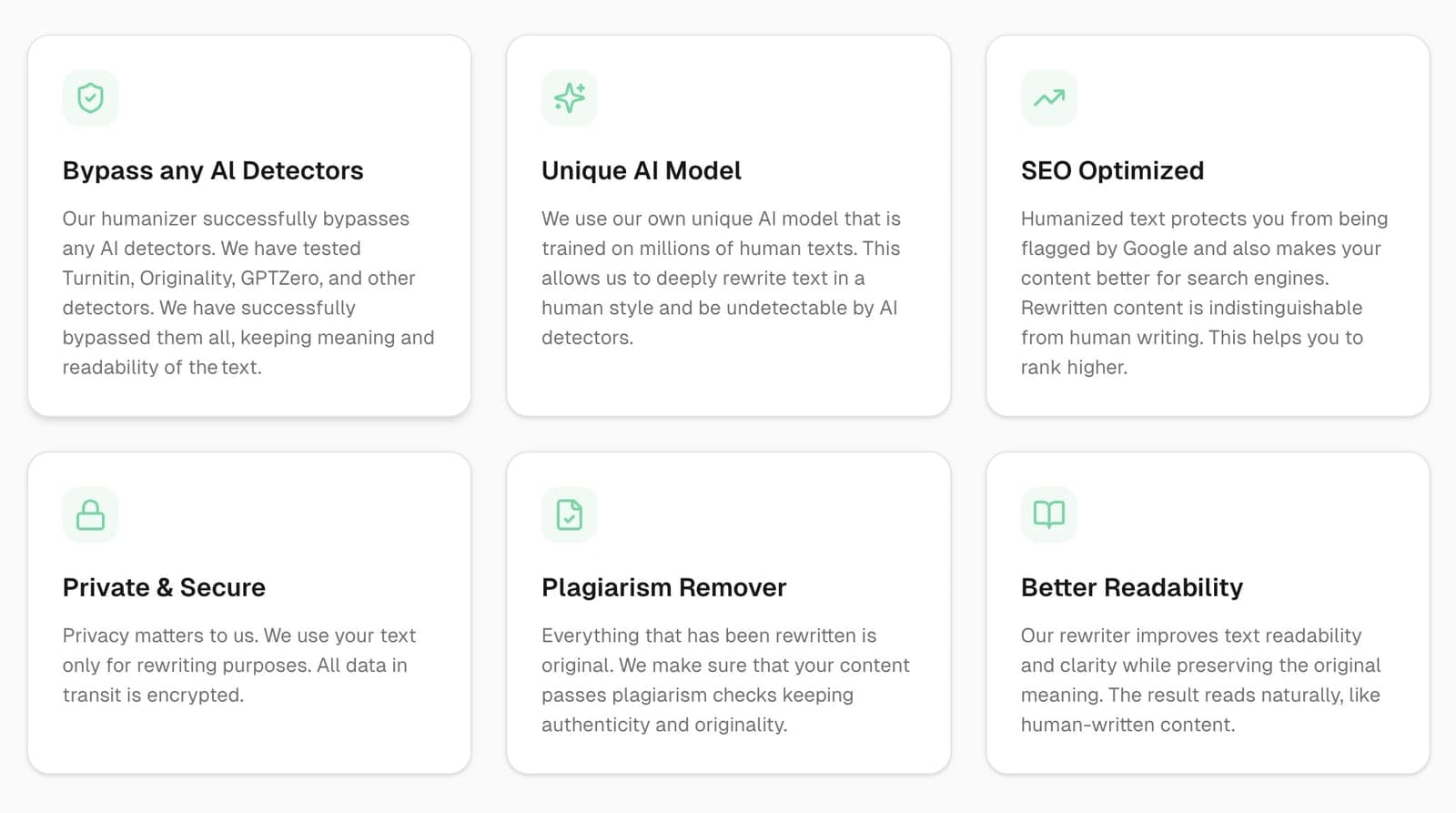
| RewriteAI | Humanizer plus its own detector and API | Ours — see the disclosure below |
Disclosure: RewriteAI is our product. We have an obvious interest in your choosing it, which is precisely why this article does not rank the tools or claim a bypass rate. Use the framework above and decide for yourself. If our output does not preserve your meaning, we would rather you found that out in a free trial than after submitting something that mattered.
The use case changes the answer
"Which is best" has no single answer partly because the requirements are genuinely different across the people asking.
Academic writing
The binding constraint is accuracy, not score. A humanizer that quietly turns "statistically significant" into "notably substantial" has changed a claim, and no detector score compensates for that. Citations, defined terms, numbers and quoted material must survive untouched.
Second constraint: document length. Essays and papers run past every free tier's per-run limit, so chunking behaviour matters more here than anywhere else.
Third, and often overlooked: register. Academic prose should sound formal. Tools tuned for blog copy inject contractions and a conversational lilt that reads as wrong in a literature review, whatever the detector says.
Marketing and SEO content
Accuracy constraints are looser, volume constraints are tighter. What matters is throughput, consistency of brand voice across many pieces, and usually an API rather than a paste box.
The detection question is also different. You are generally not facing an adversarial checker; you are trying not to publish text that reads as obviously generated to a human. That is a lower bar and a different target.
Professional and business writing
Emails, reports, proposals. Volume is low, stakes per document can be high, and the dominant constraint is confidentiality. Client material, unpublished figures, anything under NDA — the retention policy is the deciding factor, ahead of every other consideration.
Non-native English writers
A special case worth calling out, because the marketing rarely addresses it.
If English is your second language, your writing is already at elevated risk of being flagged — the Patterns study found a 61% false positive rate on TOEFL essays, and the same research showed the rate fell to 11.6% when the essays were rewritten with more elaborate vocabulary. Detectors are penalising a register, not detecting AI.
That creates an awkward incentive: the thing that lowers your score is writing less like yourself. A tool used carefully can help here, but the more durable protection is documentation of your process. Detector bias against non-native writers covers this properly.
Questions to ask before you pay
Most of these are answerable in five minutes on a pricing or policy page, and most people skip all of them.
- What is the per-run word limit, and the monthly total? These are different numbers and vendors often headline the friendlier one.
- Does the free tier use the same model as the paid tier, or a weaker one? If it is weaker, your trial tells you nothing about what you would be buying.
- Is my text retained? For how long, and is it used for training? Look for this in the privacy policy, not the FAQ.
- Can I see a diff of what changed? If not, you cannot catch a bad substitution before it reaches a reader.
- Is there an API, if you need volume?
- What is the refund policy? Tools in this category churn heavily and some make cancellation deliberately awkward.
- Does the vendor make claims it cannot support? A prominent "99.9% undetectable" with no methodology is a signal about how the company treats evidence generally.
A test you can run in ten minutes
Rather than trusting any roundup, including this one:
- Pick three paragraphs of your own writing — real work, with a technical term, a number, and a citation in it.
- Run each through two or three candidate tools' free tiers.
- Read every output against the original, specifically checking that no number, name, or defined term changed.
- Check each output against two detectors, not one. Wide disagreement between detectors tells you the score is noise.
- Read the best output aloud. If it does not sound like you, the score does not matter.
This takes ten minutes and it is worth more than every listicle in the search results, because it tests the tool against your writing in your field, which is the only case you care about.
What none of these tools can fix
A humanizer changes the surface statistics of text. It cannot:
- Make a weak argument strong
- Add the specific, concrete detail that makes writing convincing
- Give you version history proving you did the work
- Guarantee any outcome against a detector that updates next week
If you are using AI in academic work, the durable protection is not a lower score. It is a documented drafting process. We go through what actually holds up in why AI detectors flag human essays.
And if you are trying to decide whether you need a humanizer at all or just a rewriting tool, AI rewriter vs AI humanizer covers the distinction, because they solve genuinely different problems.
The short version
Every tool in this category advertises a number it cannot substantiate, against detectors that are themselves unreliable, in a market where the rankings are written by the vendors.
Judge on meaning preservation, transparency about edits, word limits, voice, and data handling. Test on your own writing. Ignore the leaderboards, this article included.
If you want to try ours on that basis, RewriteAI's humanizer has a free tier and shows you what it changed.
Keep reading
- Best Free AI Humanizer (500, 1500, 3000 Words Tested)
We tested every major free AI humanizer at 500, 1500, and 3000 word limits to find which tools actually work for free — and which are free in name only.
- Are AI Detectors Accurate? Every Published Number, in One Table
In June 2026 four commercial detectors were run over 40 papers written end to end by GPT-4o. Three of them flagged nothing. All four advertise 99% accuracy or better. Here is every published number, with its date and its source.
- How to Make AI Text Undetectable (Without Rewriting Everything)
Learn how to make AI text undetectable to GPTZero, Turnitin, Originality.ai, and every major AI detector — without manually rewriting your entire document.

Humanize AI Text and Improve Your Writing Right Now
Rewrite for clarity, flow, and readability while keeping your original meaning and writing style.