

We now live in a world where people are creating text with an AI that makes their writing sound like robots. There are a number of ways to make AI writing sound human. You may want to be a little bit crafty and devious when doing this, though what I'm really describing is "thinking critically." I like thinking of the text you receive back from any AI model as a starting point for a writer. Like a stone is just a big rock until a sculptor carves a sculpture from it, AI text is a pile of plain marble; what you make of it from there is the sculpture. I shall repeat myself one more time: never copy/paste anything from AI directly.
The simple truth to creating undetectable AI-generated text is to add a dash of human to the process, better known as humanization. Humanization is not just about taking things literally but making the text sound a bit more real, like it was written by a person, and making the text sound somewhat interesting to read. In simpler terms: Humanization is basically making the text sound more engaging, interesting to read, and sound as if it was created by a human. Below are methods you can use to simply add the human touch to your text/copy immediately as you use it right now.
How does AI detection work?
Let Your Personality & Emotions Seep into the Text
You are human, and AIs are not! Use this! This may be self-explanatory, but it cannot be understated. In an era where everything is written by impersonal AIs, if a copy sounds like it was personally done by someone you would instantly find it far more enjoyable, engaging, and – dare I say – more human! I think the best way to explain with an example is to say that something I might say could sound boring, robotic, and rather impersonal to read: "There is not enough staff to do the work." By contrast, take a different stance. Here is the alternative option I would probably go for myself: "There's no one to take your father for his daily walk." As you can see from reading that example – and there are so many possible alternatives – adding your emotion and personality goes a long way to injecting the human touch into the writing of your article or copy! Inject that emotion into the copy right now.
Use Long AND Short Sentences
Human-written text might vary in sentence length. Try to use your intuition to vary the sentence lengths! Avoid boring, repeating, monotonous text that will make the human or AI model you are deceiving realize there's some cheating going on! Nobody likes a monotonous block of sentences either; why not consider adding shorter sentences to break up longer statements? Here is an example: In short, avoid repeating long sentences over and over again.
An example:
Adding an em dash to my article above might look boring, so why not add shorter, snappier sentences to break things up a bit?
I wrote above to avoid adding an em dash to my article. So why not look at adding shorter, punchier sentences?!
Avoid AI Specific Patterns
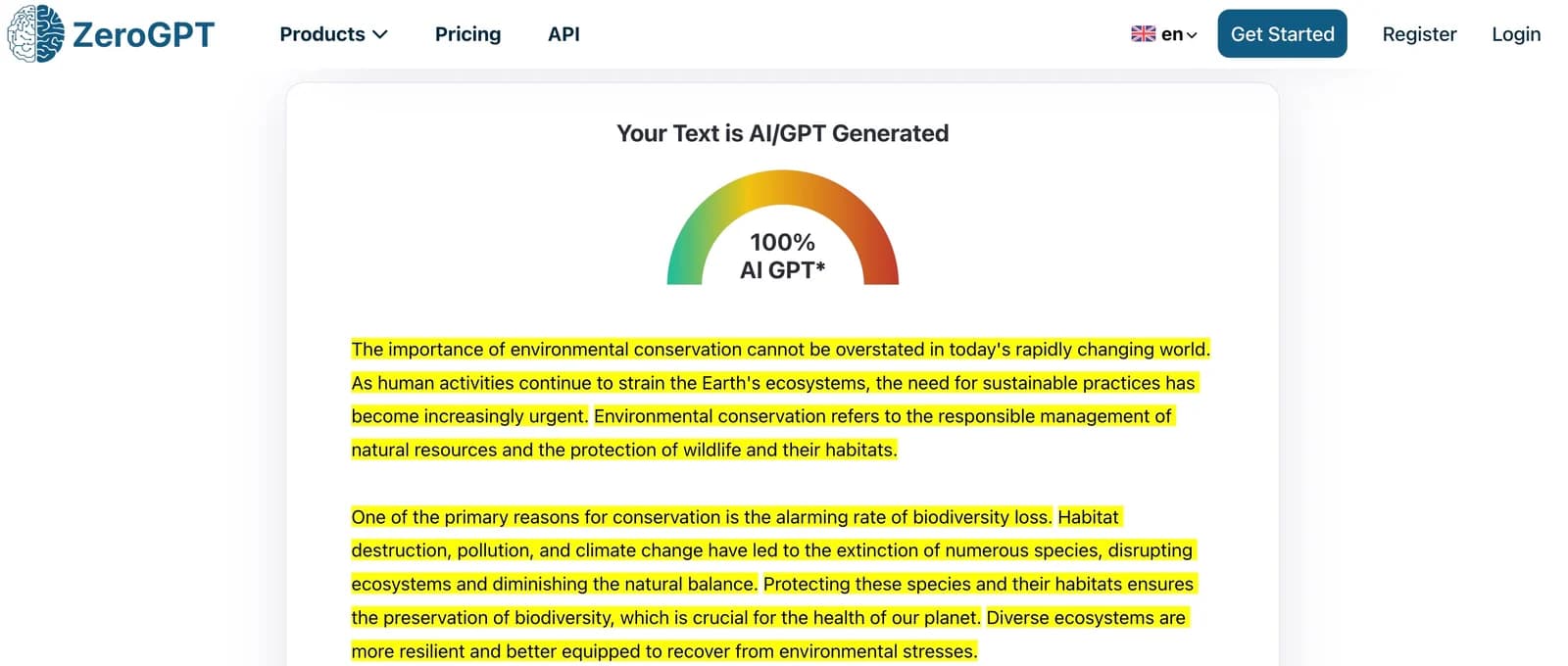
If you look at the content I write, there are a few telltale signs of content that an AI would hardly ever consider adding to their writing. As an example of phrases I might never use in my content (that AIs are prone to), consider "It is important to note." If I ever thought to add this, I would replace it with "Note that." Another telltale sign of AI writing (that I noticed in the past) is the overuse of the em dash and the frequency of title case.
Incorporate a Consistent Tone of Voice
Tone of voice is something often overlooked by everyone, and it matters! What is it that you're trying to write about as you think that way? If you're writing about math and physics, you wouldn't use such a formal tone or voice, and the same applies if you were writing jokes. You change it accordingly, don't you? So pay close attention to this; consistency will matter to keep your branding consistent too.
Get on the Humorous Train
Some humans are good at jokes, which is a skill that AIs seem to struggle with; this is a classic weakness you can exploit. Try inserting something subtle – a joke or a wry remark – that is related to the context of your discussion or something that is funny in itself; humor doesn't work well in artificially generated content, so this will easily trick an AI into thinking you are human. Humans love to see, hear, or be made to laugh, so inserting some funny tidbits, if possible, helps! Avoid the robots by injecting and adding some jokes – maybe no overly obvious ones, please!
Fact-Check What the AI Tells You
I cannot stress this enough. A common myth or honest error that someone told me and that I believed is that ChatGPT, the AI generative model I am looking at in this article, spits up hallucinated "information," facts, quotes, and sources, you name it, to those who prompt its answer. It spits up information that isn't, well, real at all. My friend had heard from somebody that ChatGPT, alongside others like Google and Bing, make up the facts that it writes. How far is this from the truth? I had to find out. Because this friend told many others, he'd made an impact. The article isn't about a particular chatbot, but you should know that many chatbots and their associated output contain mistakes, inaccuracies, and hallucinated details generated as outputs to our questions. As such, you mustn't assume what these programs like ChatGPT generate is actually real, accurate, and legit. Rather, verify it, especially if fact-heavy articles are your aim, and use your own critical skills and knowledge to check its output for authenticity's sake. You shouldn't write articles filled with mistakes.
SEO and AI Generated Texts
With the new age of SEO, AI-generated texts have been a blessing and also a curse for sites that over-rely on AI-generated texts for their blog posts. These texts give sites the ability to generate text faster than humans could, but also have negative impacts on websites due to the overuse of AI and not having any feeling, as in a human feeling, to the articles generated. Google recently launched additional bots that are better at detecting AI-generated spam. These articles are easier to generate quickly and have less complexity, original insights, and human engagement factors that Google loves among top-ranking articles. Over time, these bots start understanding patterns and nuances that AI articles will most likely contain. This means if you are planning on creating content using AI, it must be human-friendly and contain a human touch. So, content generators not only use AI as a research tool or a drafting aid but also give more importance to adding soul, original thoughts, and a conversational and humanlike voice to their generated text. If you want to use a more human approach to written SEO, avoid getting penalized by Google due to reliance on AI-generated text and want to make sure your content reads high quality, not only for users but also for Google, make sure you follow this strategy for your SEO approach.
The Paid Option
Of course, for those who want the easy option, there are numerous sources that pledge they will add these kinds of traits to artificially generated writing outputs. One such option is something called RewriteAI.com. This platform promises to deliver results quickly to take copy generated by AI and make a number of edits. These include focusing on the tone to make the copy read as human-written, as well as helping bypass all AI detection. This type of paid service is handy for humanization, but you can start to inject a human touch immediately using the free techniques above that I have described. The paid option is incredibly practical for those with a huge volume of content to humanize. See our Best AI Humanizer comparison and How to Humanize AI Text for Free for more options.
Keep reading
- AI Humanizer Comparison: How to Actually Judge One
PaperBleach, Rephrasy, Rewritely, NaturalWrite, JustDone — they all advertise near-perfect bypass rates and none of them can prove it. Here's a framework for judging them that does not rely on anyone's marketing.
- How to Make AI Text Undetectable (Without Rewriting Everything)
Learn how to make AI text undetectable to GPTZero, Turnitin, Originality.ai, and every major AI detector — without manually rewriting your entire document.
- Best Free AI Humanizer (500, 1500, 3000 Words Tested)
We tested every major free AI humanizer at 500, 1500, and 3000 word limits to find which tools actually work for free — and which are free in name only.


Humanize AI Text and Improve Your Writing Right Now
Rewrite for clarity, flow, and readability while keeping your original meaning and writing style.