

Artificial intelligence has changed how we create content. Programs like ChatGPT make it possible to publish articles, emails, and social media posts in seconds. That's incredible! But there's one problem: The output can sound pretty...robotic. It can be generic, overly formal, and devoid of the "special sauce" that makes humans actually want to read it.
Now the good news: You don't have to buy expensive software or subscribe to anything. Learning to humanize AI text is simple, and it's a skill that will grow with practice. This guide will show you the practical (free!) techniques you can use right now to turn lifeless AI text into compelling, authentic, and utterly irresistible prose. For a tool comparison, see our Best AI Humanizer and How to Avoid AI Detectors.
Stop the Robot!
First, we have to be able to identify the problem. Once you understand what the robots tend to do, you're halfway to fixing it. AI models generate text using inputs from the internet - vast datasets of human-written content. Over time, the models develop habits and behaviors that are consistent across pieces, giving off an almost distinct scent that I like to call the "AI accent."
Overly Perfect Grammar and Structure
Sometimes, there's nothing specifically "wrong" with the text, but it fails the gut check: AI can generate sentences that are completely grammatical and follow complex sentence structures, but this can lead to dryness and monotony, totally destroying the natural flow and "rhythm" that humans use.
The "Listicle" Habit
Yes yes, we know. I'm writing a listicle right now. But a massive part of how Google categorizes content these days comes from things like listicles or articles or social media text that make strong use of number series or bullet-style points. These items have been used and, unfortunately, abused by AI to write so many different types of article that look and sound like technical manuals rather than engaging guides or lists for people to read.
The dreaded "sentence starters"
One of the best indicators that an AI generated any text for you is sentence starters. This comes in the following flavors:
- "In conclusion..."
- "Furthermore..."
- "Moreover..."
- "It is important to note that..."
- "Additionally..."
Humans use these starts to sentences, but nowhere nearly as often as AI uses them (since AI has no understanding of human relationships when building text).
Lack of 'I'.
AI by default provides no sense of humans, what humans think or feel. AI hasn't lived and breathed air, eaten, slept or had relationships. It has zero lived experiences as a human being.
"Hedging."
This is the act of an AI saying "this could be" instead of "this is." AI cannot take any risks saying such things, so it uses phrases such as "can be", "may lead to", "it is possible that" etc. This also lends a strange sense of weakness in the overall writing, as if the AI is unsure of its output. This is not what should be happening with any style of text. AI doesn't like saying something with conviction.
Strange vocabularies
Used like robots, some words get used over their common cousins: Words like "utilise" over "use", for example. Nobody goes around saying utilise, but, apparently, many AI-generated websites do and do often.
The Most Essential Tool: Manual Rewriting
Now it's time for the absolute most powerful tool: using your own hands for a rewrite. And no, this isn't about starting from scratch. It's about seeing the AI draft as a lump of clay, and using your expertise "sculpt" it into what you want.
Technique 1. Throw Away the Robot and Inject Some Human
Now it's time to add the secret sauce: Your own thoughts and ideas.
- Using "I" and "You": Change "one might find..." to "you might find..." - the easiest way to make a connection!
- What's YOUR personal perspective on this? In your experience, how has this helped, or happened with regards to '...' in YOUR life?
- "I believe that..." and / or "In my experience..."
Sharing Anecdote / Personal Human Story
Did the article generate a nice paragraph about tips you can use to deal with time management from the article? Share a quick anecdote in your real life when this came up! Story is incredibly human.
For example;
In AI Generated Text: Effective time management is crucial for productivity. It involves prioritizing tasks based on urgency and importance.
In the Humanised Text: I used to be terrible at time management. "My to do list" was a mile long, and I'd get to the end of each day feeling stressed, overwhelmed and frazzled - like as if I'd actually accomplished little. "For me the game changer" was simply learning to separate out the things that were urgent (and for me, for which I am a notoriously a victim of other people and organisations making me do things - i.e., tasks like filing that invoice and chasing it, etc), from what's important to me. Its simple, but makes all the difference.'
Technique 2. Mix 'Em Up
What? Vary Their Structure and Length, Of Course!
Have you not read this far? It can be as simple as choosing a punchy single-sentence paragraph among longer ones. Short and long sentences can exist in human text; in fact mixing the two creates a great reading experience. We cannot mix short and long-form text at all.
In AI Generated Text: Gardening is a beneficial activity. It can reduce stress and improve mental well-being. It also provides an opportunity for physical exercise.
In the Humanised Text: Gardening is so much more than just a hobby. For me, it's one long therapy session, with the calm action of planting, watering and digging my reward and the "feelings" associated with them very cathartic. Plus, it's an amazing way to get some exercise too!
Technique 3. Simplify, Add Slang?
Of course you! The robots use complex words. You don't need to use that.
For example; Instead of "utilise", try "use", rather than "ascertain", find out, and rather than 'subsequently', simply say later or next.
No you're not!
What About Contractions?
Change "do not" to "don't," "it is" to "it's," and "you are" to "you're". You'll be much more conversational in your phrasing in no time!
What About Slang?
"Well ... depends on your overall brand tone and voice!" The goal isn't to throw slang into everything, but you never know when a fitting comment about an "old wives' tale" or modern slang for in-the-know Gen Z types might come into play. Don't go wild with slang or other contemporary parlances, but a little bit goes a long way.
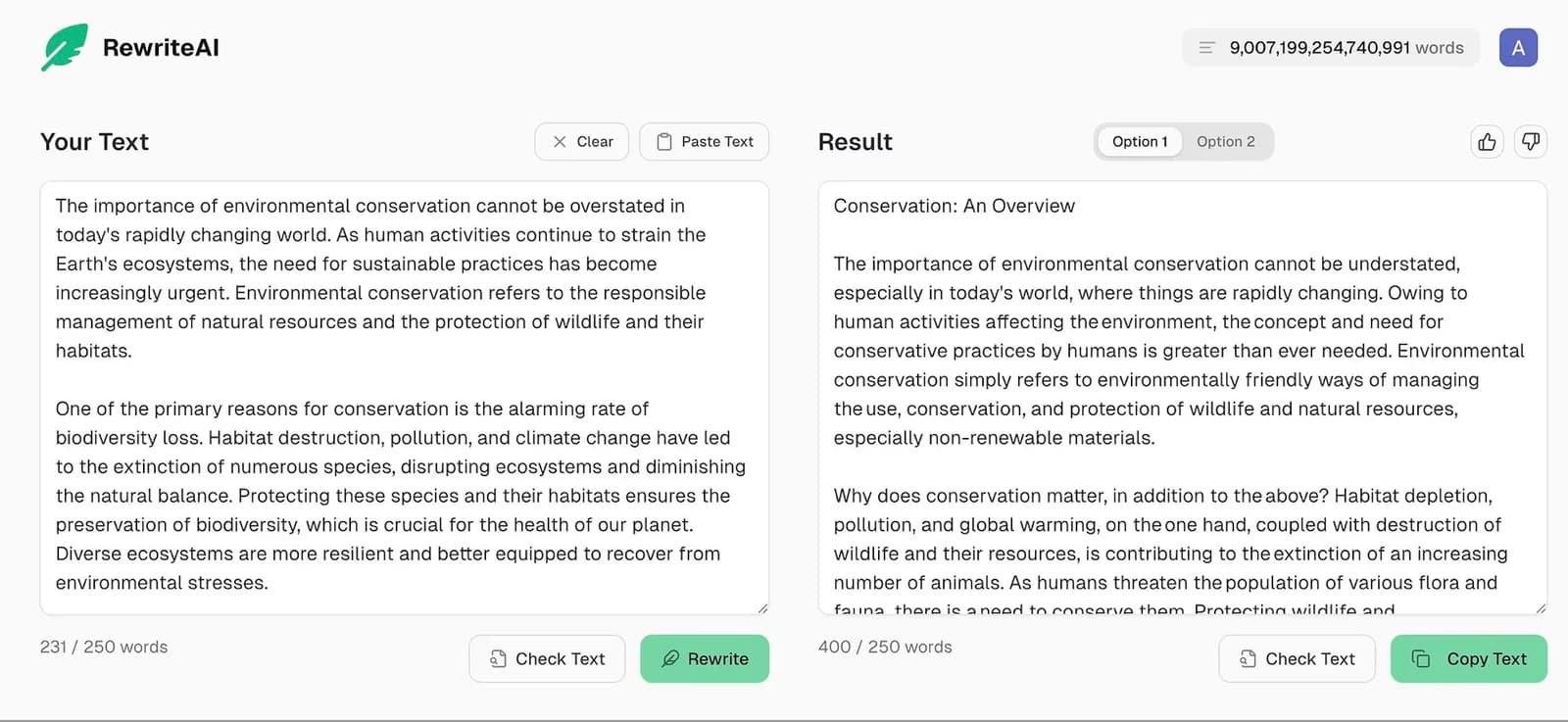
Free Software to Aid Your Edit!
If you want your robot text to not look totally bland, there's a handful of awesome (free!) tools on offer to boost your text into human life. But don't expect them to use magic here - human editing is still required!
-
RewriteAI (rewriteai.com)
RewriteAI is a free tool that can help you humanize your AI text. It has a free plan, and the limit renews every month. RewriteAI is a humanizer that uses specially trained AI model to not just paraphrases your AI text like others do, but also deeply rewrites your text.
-
Hemingway Editor (hemingwayapp.com)
There are plenty of readability tools on the market, but the majority aren't nearly as clean or beautiful to use in the same way as Hemingway can deliver and also (it's free!). They can help humanise an AI article by looking at these things:
- Finding and highlighting sentences that are simply just too long (15+ words)
- High frequency flags for using the passive, AI love these.
- Flagging words it thinks aren't easy to be replaced.
- High frequency adverbs. These typically weaken a sentence.
By implementing these "suggestions" by the article editors, you will naturally be humanising it.
-
Grammarly Free Version (grammarly.com)
When most people talk about Grammarly, they often do so in connection with paid models, but the free version works well as a check for standard grammar and spelling corrections. Because of the robotic nature where AI takes what is already provided to it by humans, this means it rarely presents any grammar or spelling issues and rarely has typos (especially if this is an article that's been on the first page of Google for ten years!). Humanising an article often consists of changing various words and phrases, however, and this means humans have to check over themselves if the text generated by them is right.
How to manually humanize AI text
This is how, the Strategic Prompting Method
Now we get into the serious business of the human article. To significantly reduce the manual writing and editing required, you simply have to teach AI how to not be so robotic, and become human. The reality is AI will never fully humanise, but we can start building our prompts to human-style text generation at scale in this method I call Strategic Prompting.
Assign It a Persona
Tell AI "who" to write with.
Example: You're a friendly and encouraging fitness coach. Write a blog post about overcoming getting stuck with the same workouts.
Tone and Voice
Is this how we want to convey this message? Be very specific on specifying tone of text when generating.
Example: Write me an email in this theme, to send to a new customer who has decided to use our service. You will use a friendly tone, warm welcome and humorous feel when messaging them! The goal is to create a friendly experience when receiving the email.
Conversational Style
We're already halfway with this!
Example: Now write it in a new style thats for my best friends. Explain the way the blockchained way is, and what one can do with or about it (analogies and contractions also permitted!). Talk to me as this is a human explaining about blockchain to your mates down pub.
Can You Just Go to It (and Replace It?)
Example: If you think, in your head there is more human things to say to kick it off, just type it in! You can now just delete that item in that place! For example, if I wanted to say: ''Include a short, personal anecdote about a time [INSERT PERSONAL STORY ABOUT MISSING A DEADLINE].''

And In Case You're Curious... A Word on Paid Tools with Free Tiers.
The reality of AI, which is still in its fledgling years, is constantly changing. Most of the AI rewriting and humanising services operate on a subscription business model. However, others operate more towards "free tiers."
Why bring this up? Because sometimes its not bad to not pay in your articles, just yet! A handful of services like RewriteAI and others, often have a free tier they operate in letting humans test their article generation tools. These free tier credits, and or words per day / month is usually limited.
Why would I use these?
In situations like:
- You have 1 paragraph thats bothering you, as its very stubborn and will not humanise, so you just copy it, run and come back with a different version!
- You dont know how to rephrase a sentence that's plaguing you; use an Ai to give an alternative way, and change it hows ever fits the way that you want it.
Test out how the AI services like a robot that is supposed to be smarter than humans is; but requires a prompt. Its the best way to test for yourself, without any financial commitment whatsoever.
Remember to keep it human! (free!)
Ultimately, there will be no better humaniser than you - your lived experience is yours; and what you give to the article using your words and voice, nobody can ever, or never will, replicate. Using AI, brilliant at drafting articles, and your own human intelligence with one of the free or potentially paid tools to humanise your robots article, you will be in the enviable position of creating incredible text, with incredible ease, every article, blog post, poem, social content and more!
Keep reading
- Grubby AI Review: I Read the Guarantee and the Terms (2026)
Grubby AI's guarantee page promises a 100% Turnitin bypass with no fine print. Its contract says all purchases are non-refundable and routes the guarantee to a section that never mentions refunds. Here is what the documents actually say.
- Walter Writes AI Review: What the Free Humanizer Actually Did
Walter Writes AI's free humanizer moved a 255-word AI sample from 99.2% to 92.8% on Sapling and not at all on GPTZero. Its own built-in detector called the same text 22% and human.
- Grammarly AI Humanizer Review: I Tested It Against Three Detectors
Grammarly's free AI humanizer rewrote my test paragraph well and preserved every fact. Sapling still scored the result 99.1% AI. Grammarly's own detector said 0%.


Humanize AI Text and Improve Your Writing Right Now
Rewrite for clarity, flow, and readability while keeping your original meaning and writing style.